
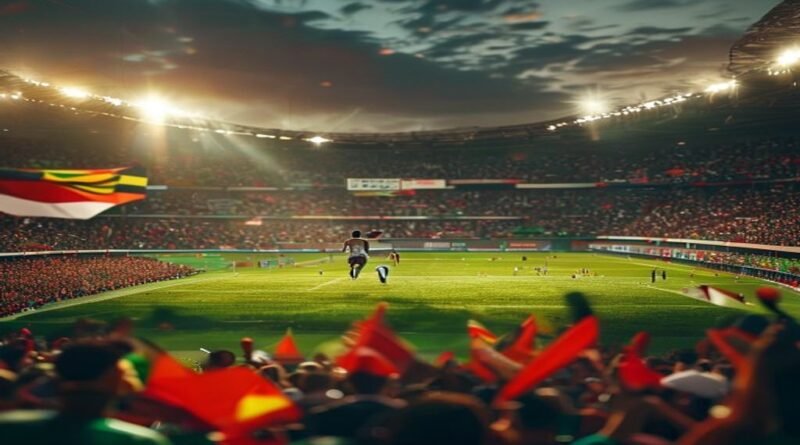
One Ball, Eight Billion Hearts: Why the FIFA World Cup Unites the Planet
There are few moments in modern life when the planet appears to move as one. A solar eclipse, perhaps, or a New Year that rolls westward across the time zones. And then there is the FIFA World Cup, the only recurring human event that persuades farmers in the Andes, office workers in Tokyo, taxi drivers in Lagos and students in Reykjavik to pause at the same instant and stare at the same rolling ball. No other spectacle gathers so much of humanity into a single shared experience.
A Game Anyone Can Play
Football’s global reach begins with its beautiful simplicity. It requires no expensive equipment, no manicured court, no specialist gear. A ball of rolled-up plastic bags and two stones for a goal are enough. Because the barrier to entry is almost zero, the game took root in every kind of place, from the wealthiest suburbs to the poorest informal settlements. That universality means that when the World Cup arrives, billions of people are not merely watching a sport they admire from a distance. They are watching a refined version of something they themselves have played, and that intimacy of understanding turns spectators into participants of the imagination.
The competition also carries a rare democratic promise. In many global sports, the same handful of wealthy nations dominate decade after decade. Football is different enough to keep hope alive. A small country can, on a given afternoon, humble a giant. The knowledge that an underdog might topple a favourite gives every nation, however modest, a reason to believe that its month in the sun could come.
The Theatre of Nations
Part of the tournament’s magnetism is that it briefly transforms sport into a story about identity. When a national team walks onto the pitch, it carries the hopes, the history and the self-image of an entire people. For ninety minutes, abstract ideas about who a nation is become gloriously concrete, expressed through a style of play, a favourite son, a way of celebrating. Supporters see in their team a mirror of how they would like the world to see them: brave, inventive, resilient, joyful.
This is why the emotions run so impossibly deep. Grown adults weep in the streets. Strangers embrace. Entire cities fall silent and then erupt within the space of a single second. The World Cup gives ordinary citizens permission to feel things collectively that daily life rarely allows, and it does so on a stage the whole world is watching.
The World Cup is the rare arena where a nation can announce itself to the planet not through power or wealth, but through grace, courage and a well-timed goal.
A Festival That Travels
Because the host country changes each cycle, the tournament functions as a kind of rotating global festival, carrying the world’s attention to a new corner of the map every four years. Host cities scrub themselves clean, string up lights and throw open their doors to visitors who arrive speaking dozens of languages. For a few weeks, borders feel thinner. Fans who might otherwise never meet trade scarves, learn each other’s chants and discover that rivalry on the pitch can coexist with warmth off it. The event becomes a crash course in the essential likeness of people who assumed they had nothing in common.
There is a shared vocabulary, too. Across continents, people who cannot converse in a common tongue can still communicate through the grammar of the game. A raised eyebrow at a missed chance, a groan at a poor decision, a gasp at a moment of brilliance, these are understood everywhere without translation. Few things bind humanity so effortlessly.
The Weight and the Wonder
None of this is to pretend the tournament is free of complication. Hosting carries enormous costs and difficult trade-offs. The sport’s governing structures have faced hard questions about fairness and transparency. Commercial pressures shape the spectacle in ways that not everyone welcomes. To love the World Cup honestly is to hold its wonder and its problems in the same hand, and to insist that an event capable of uniting the planet should live up to the ideals it inspires.
Yet even the sharpest critics tend to fall quiet when the whistle blows. The reason is simple. For all its flaws, the World Cup delivers something scarce and precious: a sense that, however divided we are by geography, language, faith and fortune, we can still be captivated together by the same small drama unfolding on a rectangle of grass.
That is the quiet miracle at the heart of it. In a fractured age, the World Cup remains proof that shared joy is still possible on a planetary scale. One ball, twenty-two players, ninety minutes, and for a few unforgettable weeks, a species that struggles to agree on almost anything agrees to watch, to hope and to feel as one. Nothing else on Earth does quite the same thing, and that is why, every four years, the whole world stops to watch.
