
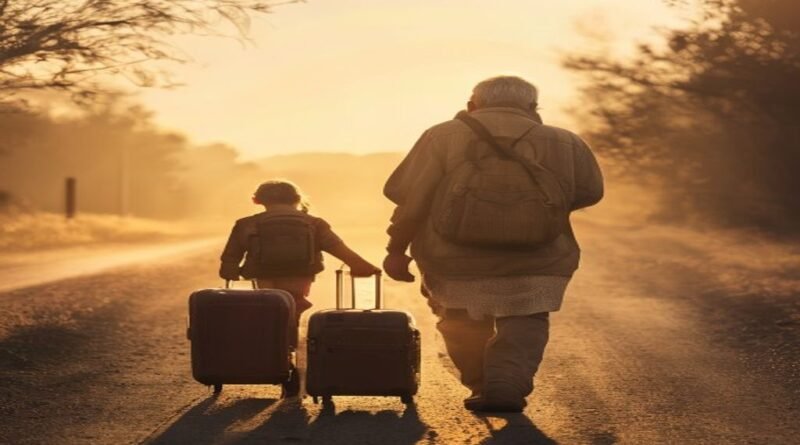
People on the Move: The Human Story Behind Global Migration
At any given moment, a significant share of humanity is living somewhere other than where it was born. Some crossed a border for a better job, some fled a war, some followed love or family, and many left for reasons that resist simple labels. Migration is among the oldest human activities, older than any nation that now tries to regulate it, yet public conversation flattens this vast reality into a handful of charged words. Recovering the human texture behind the numbers is not soft sentiment; it is the precondition for thinking clearly about one of the century’s defining forces.
The Categories That Never Quite Fit
Officials sort people who move into tidy boxes. There are migrants, who are presumed to choose, and refugees, who are recognized as forced. The law depends on this distinction, and it matters enormously, because refugees are entitled to protections that ordinary migrants are not. Yet the lived reality rarely respects the boundary.
Consider the farmer whose land has become too dry to feed a family, or the young person in a place with no jobs and no prospects, or the family fleeing not a declared war but a slow collapse of order. Are they choosing or fleeing? The honest answer is usually both. Human decisions to leave home almost always blend push and pull, desperation and hope, constraint and agency. The categories are necessary for administration but treacherous as descriptions of actual lives.
Why People Leave, and Why It Is Never Easy
A persistent myth holds that migration is easy, an impulsive grab at greener grass. Anyone who has spoken with people who have moved knows the opposite. Leaving home means severing yourself from language, community, familiar streets, aging parents and the graves of ancestors. It is one of the hardest things a person can do, and most who do it would have vastly preferred to stay if staying had been survivable.
Almost no one abandons everything they know for a difficult, uncertain future unless the alternative is worse. Migration is usually a symptom, not a whim.
The forces that set people in motion tend to cluster. Among the most common are these:
- Violence and persecution that make ordinary life impossible
- Economic collapse or a simple absence of any path to a livelihood
- Environmental pressures, from drought to flood, that erode the land itself
- The pull of family already established elsewhere
- The universal human wish to give one’s children a chance the parents never had
The Journey and Its Perils
Between leaving and arriving lies the journey, and it is here that the human cost is steepest. Routes that look like arrows on a map are in reality gauntlets of deserts, seas, checkpoints and predators. Smugglers profit from desperation. Borders that have hardened push people toward more dangerous crossings rather than stopping the movement itself. Many who set out never arrive, and their stories vanish without record.
Those who do reach a destination face a second journey that is less visible but no less demanding: the long work of building a life among strangers, often without the language, without recognition of hard-won qualifications, and under the weight of suspicion. The image of the migrant as a burden ignores how much labor, ingenuity and sheer resilience the process demands from the people themselves.
What Receiving Societies Gain and Fear
Debates about migration in destination countries tend to swing between two exaggerations. One casts newcomers as an unalloyed gift, the other as an existential threat. The reality is more balanced and more interesting. Societies that have absorbed newcomers over generations have generally been enriched by them, in labor, in enterprise, in culture and in the simple demographic vitality that aging populations badly need.
At the same time, rapid arrivals genuinely strain housing, services and social trust, especially when integration is left to chance rather than actively supported. Ignoring those strains does not make them disappear; it cedes the conversation to those who would exploit them. The societies that manage migration best are neither those that pretend it costs nothing nor those that treat it as invasion, but those that plan for it honestly as the permanent feature of the modern world that it is.
Seeing the Person, Not Just the Number
The deepest failure in how we discuss migration is the loss of the individual behind the aggregate. A statistic cannot be afraid, cannot love its children, cannot mourn the home it left. When migration becomes purely a matter of quotas and flows, it becomes easy to forget that every figure represents a person who once had an ordinary life and made an extraordinary decision to change it.
None of this dictates any particular policy. Reasonable people disagree about borders, numbers and rules, and those disagreements are legitimate. But whatever policies societies choose, they will choose better if they begin from an accurate picture of who is moving and why. The people on the move are not an abstraction. They are, in the most literal sense, us in another set of circumstances, and any wisdom on the subject starts by remembering that.
