
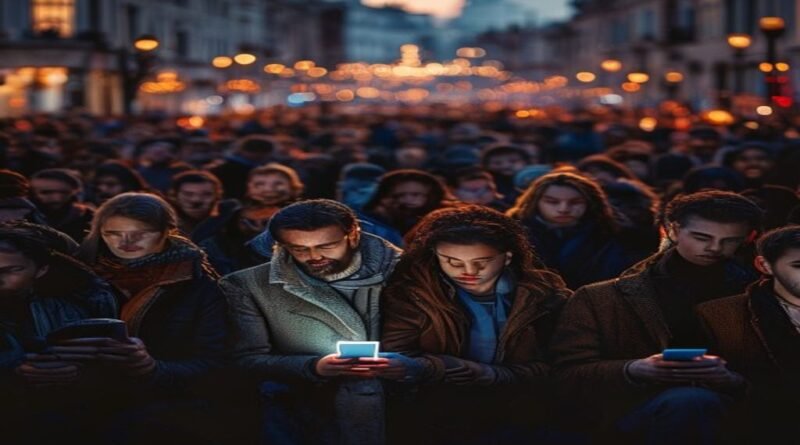
The World in Your Pocket: How Social Media Connects and Divides a Global Public
Never before has it been possible for a farmer, a student, a head of state, and a stranger on the other side of the planet to speak in the same space, at the same moment, on equal footing. Social media collapsed the distances that once separated human beings and handed billions of people a printing press, a broadcast tower, and a public square, all in a device that fits in a pocket. The consequences of that gift are still being tallied, and they cut in every direction at once.
The Great Connection
It is easy, amid the criticism, to forget how genuinely revolutionary the connective power of these platforms has been. Families scattered across continents stay woven into one another’s daily lives. Diaspora communities preserve languages and traditions that distance once eroded. People with rare illnesses or unusual passions find others who share them, ending isolation that earlier generations simply endured.
The democratizing force is real too. Movements that would once have been invisible can now find a global audience overnight. Ordinary witnesses have documented events that powerful interests would have preferred to hide. Voices long excluded from traditional media have built audiences of millions without permission from any gatekeeper. For all its flaws, social media has given a hearing to people who never had one before.
The Same Tools, the Opposite Effect
And yet the very features that connect also divide. The platforms are engineered to capture attention, and few things capture attention like outrage, novelty, and conflict. Content that provokes strong emotion spreads faster than content that informs calmly. Over time, this dynamic rewards the loud over the thoughtful and the extreme over the measured.
The architecture of engagement does not care whether it is uniting or inflaming us. It cares only that we keep looking.
The result is a strange fragmentation. A tool that could expose people to the full diversity of human thought instead tends to sort them into like-minded enclaves, each with its own facts and its own villains. People encounter opposing views not through genuine dialogue but through caricature, mediated by algorithms that amplify the most provocative examples. Connection and division turn out to be two products of the same machine.
Truth Under Pressure
Perhaps the gravest challenge is what these platforms have done to the shared sense of what is true. When anyone can publish and everything competes for attention, falsehood often travels faster than fact, because it can be crafted precisely to be irresistible. Rumors, conspiracy theories, and deliberate manipulation spread across borders in hours, sometimes with real-world consequences that are difficult to reverse.
The difficulty is compounded by scale. The sheer volume of material posted every second overwhelms any effort to check it. Efforts to moderate content run into hard questions with no clean answers.
- Who decides what counts as harmful or false, and by whose values?
- How can rules written in one culture apply fairly across dozens of others?
- Where does protecting people from harm end and censorship begin?
Different societies answer these questions differently, and the platforms, operating globally, are caught in the middle, pleasing no one entirely.
A Generation Shaped by the Feed
For younger people especially, these platforms are not an addition to social life but its central stage. Friendships, reputations, and self-image are built and tested in public, subject to the relentless comparison that curated feeds encourage. Researchers and parents alike worry about the effects on attention, mental health, and the capacity for the slow, uncomfortable work of genuine relationships.
The picture is not uniformly bleak. Many young people use these tools with real sophistication, building communities, learning skills, and finding support. But the design of the platforms, optimized to maximize time spent rather than well-being, tilts the field in ways that even their most fluent users struggle to resist.
Toward a Healthier Public Square
None of this is destiny. The platforms are designed, and what is designed can be redesigned. Growing awareness of their harms has spurred experiments in different directions: features that encourage reflection before sharing, systems that reward quality over volume, and regulations that demand transparency about how content is amplified. Users, too, are growing more discerning, learning to treat their feeds with the skepticism they deserve.
The deeper truth is that social media reflects us. It amplifies our generosity and our cruelty, our curiosity and our tribalism, our hunger for connection and our appetite for conflict. Learning to live wisely with the most powerful communication tool ever built may be one of the central tasks of the age, and it is a task no algorithm can complete for us.
